Siloam Baptist
Pioneer preacher Charles Crow founds Siloam Baptist Church in June 1822, as the town itself takes shape. Its Greek Revival sanctuary, dedicated in 1849, is on the National Register.
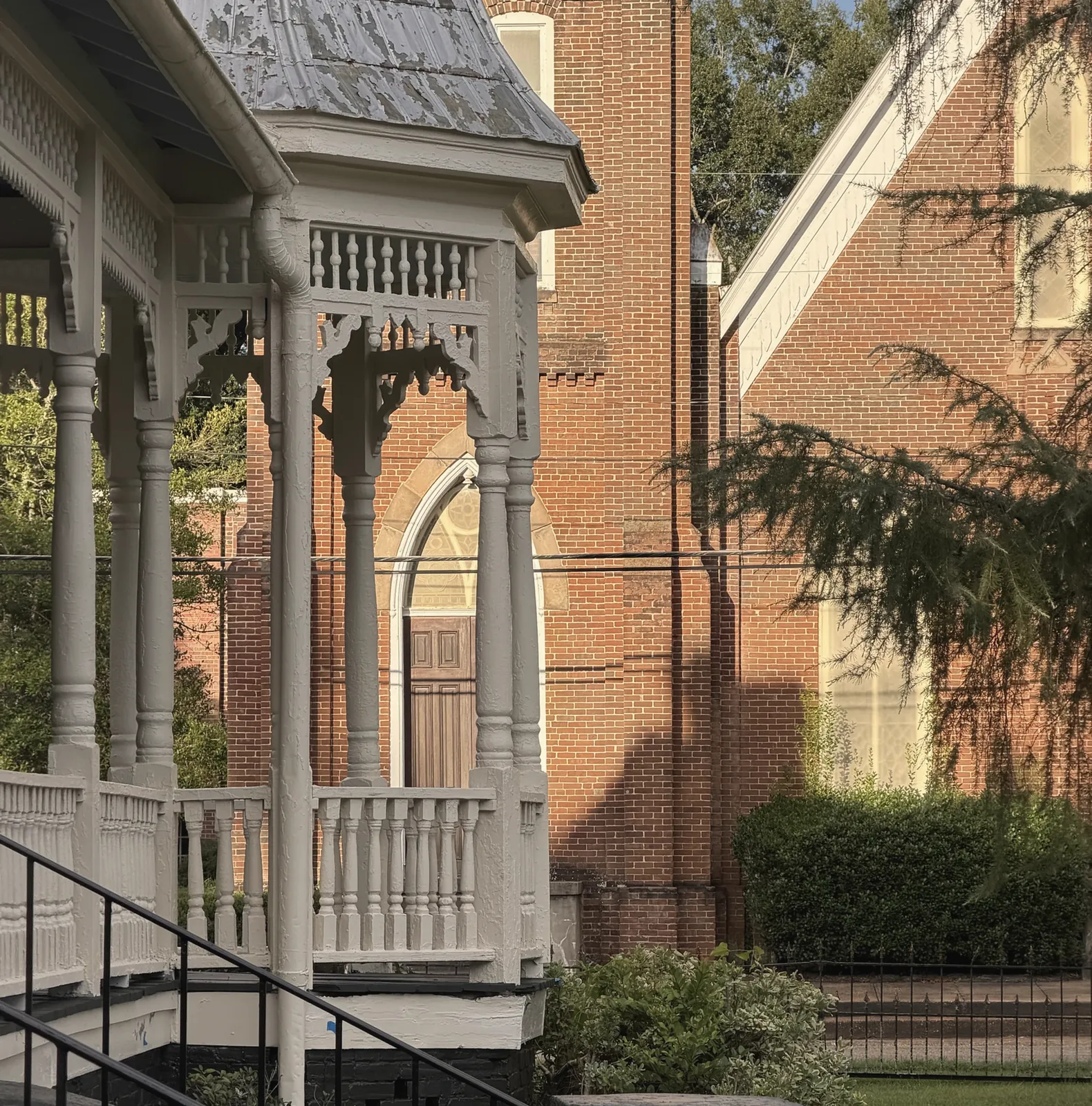
Historic Marion, Alabama
The Scott-Hanna-Moore House, c. 1834: from Scott Station to West Monroe Street, nearly two centuries in Alabama's Black Belt.
History
Few houses in Alabama have a story like this one. It was raised in the countryside in the 1830s, taken apart seventy years later, and hauled into town by twenty-five teams of mules, where it was rebuilt and enlarged into the Gothic Victorian home that stands today.
For seventy years the house stood in the Perry County countryside near Scott Station, where Samuel Madison Scott had raised it in the 1830s. It was a single-story house then, and it survives today as the upper floor of the home. Climb the stairs and you walk on its original 1834 floorboards: wide, rough-hewn planks cut nearly two centuries ago. The National Register survey found clues outside too: the upper facade has fewer bays than the lower, and its windows use different panes.
Around 1904, the house was dismantled and loaded onto 25 mule-drawn wagons, and was enlarged and rebuilt as a Gothic Victorian.
Picture the procession: twenty-five wagons stacked high with a house, mule teams leaning into the load, and a whole home rolling slowly into town.
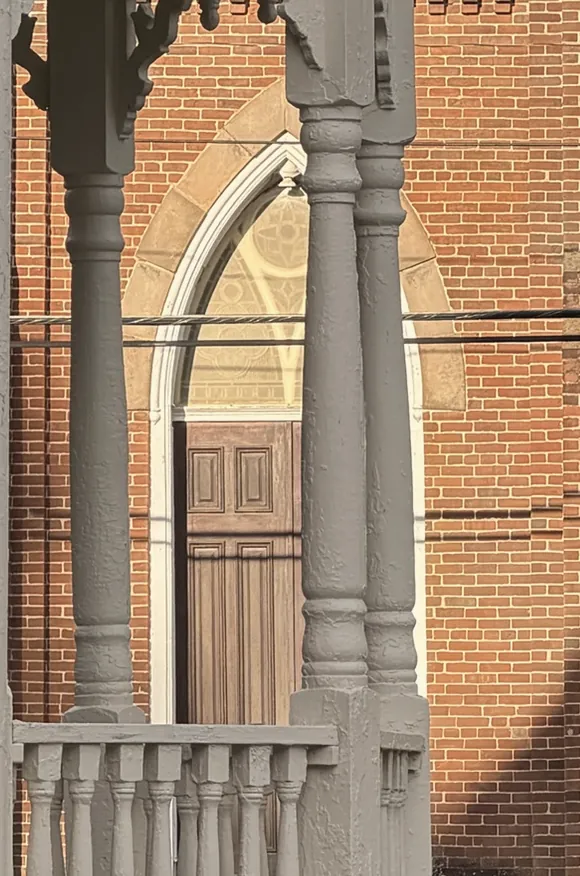
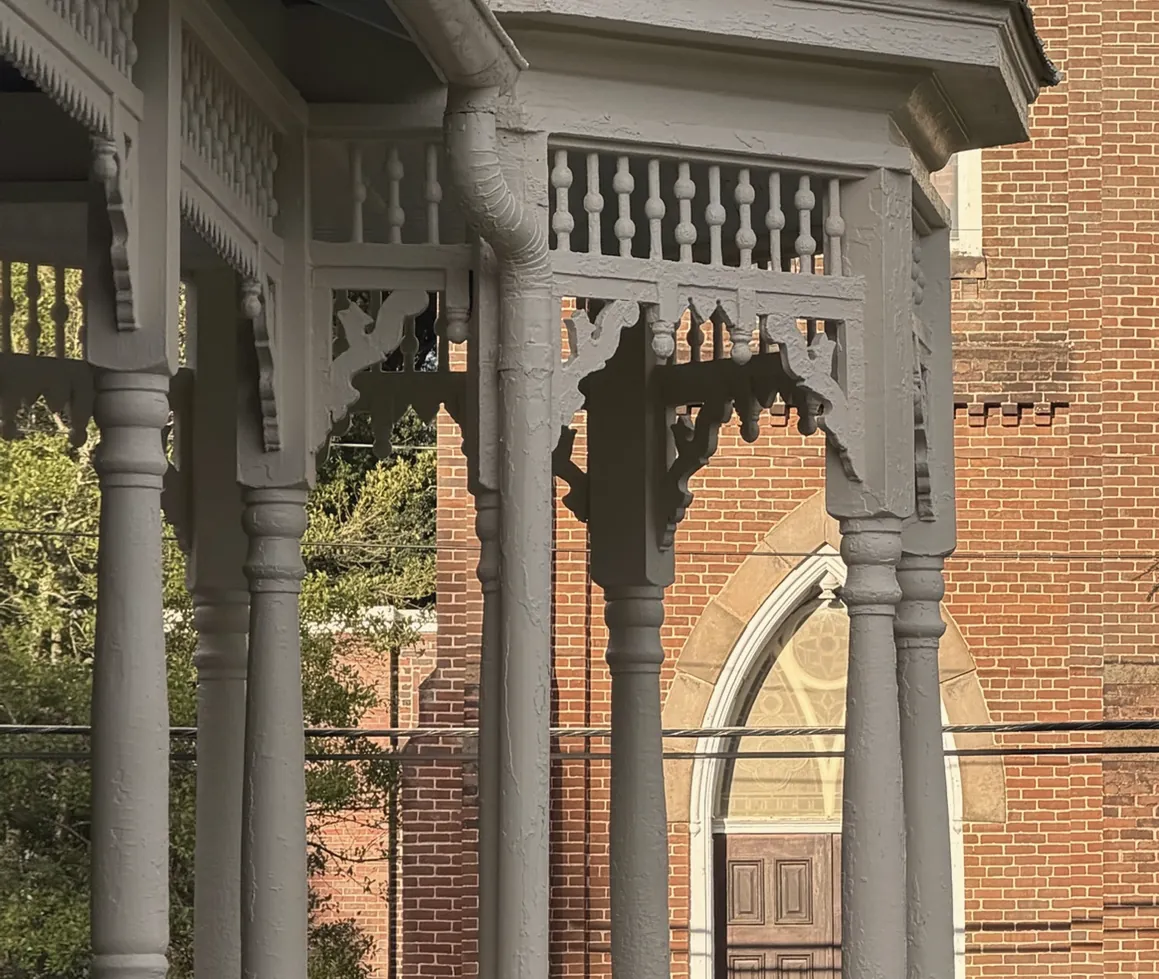
On West Monroe Street, near the courthouse square, the wagons were unloaded and the house did not simply go back together. The one-story country house of the 1830s was raised to become the second story, a new ground floor was built beneath it, and the whole rose again as a two-story Gothic Victorian, with gables, decorative brackets and a wraparound porch of turned posts and spindlework.
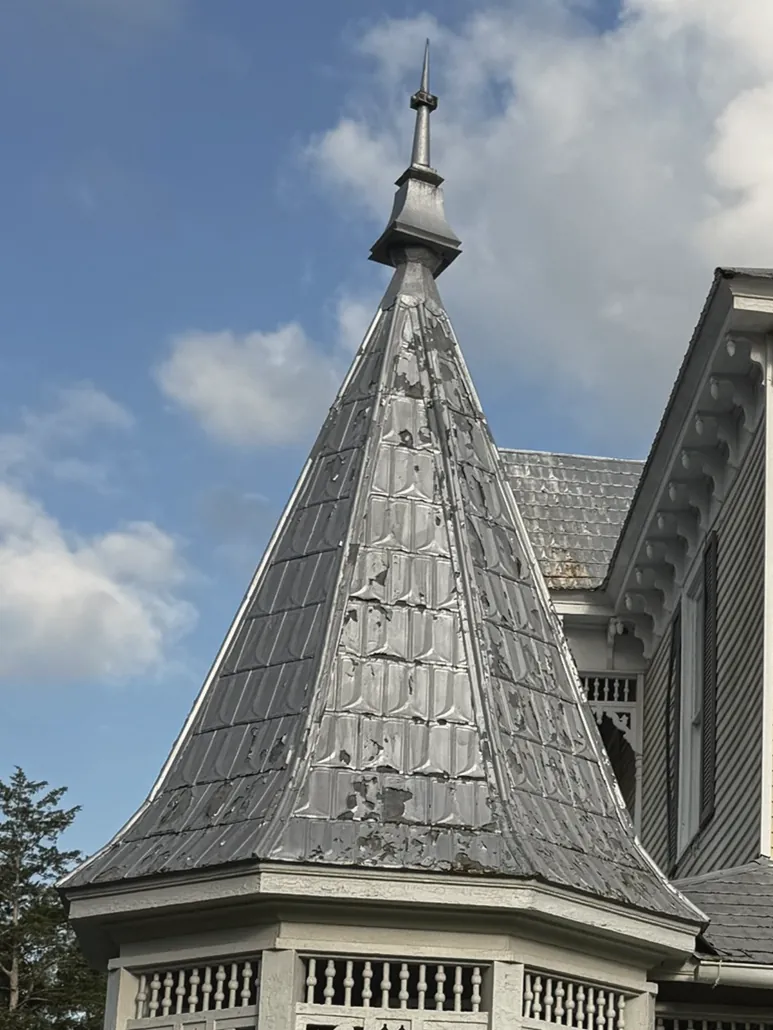
In 1910 the porch was carried out into the octagonal gazebo with its pointed tin roof, completing the silhouette Marion knows today.
More than a century on, it still stands where those wagons left it.
Samuel Madison Scott builds a frame country house in the Perry County countryside near Scott Station. The single-story house survives today as the upper floor, its rough-hewn wide floorboards still in place.
The house is dismantled and carried into Marion on a train of 25 mule-drawn wagons, then rebuilt and enlarged at 102 West Monroe Street: the original house becomes the second story above a new ground floor, creating the two-story Gothic Victorian, near the courthouse square.
The full-width wraparound porch is extended into the octagonal gazebo, finished in spindlework, turned posts and paired brackets, that gives the house its signature silhouette.
On February 16, 1996, the house is listed on the National Register of Historic Places as a contributing property of the Marion Courthouse Square Historic District, along with its c. 1904 garage and smokehouse.
The house takes the name of its newest stewards. Its owner, a renowned gardener, is carefully restoring it and planting a Southern-inspired garden of historic roses on its grounds.
A name carried forward
Known in the National Register as the Scott-Hanna-Moore House, the home has always carried the names of the families who kept it: Scott, who built it; Hanna and Moore, who followed. VanCleave Hall continues that tradition for the family restoring it today.
Listed on the National Register of Historic Places. Recorded as the Scott-Hanna-Moore House, inventory no. 68, a contributing property of the Marion Courthouse Square Historic District (reference no. 96000111, listed February 16, 1996). It stands among the district's historic buildings with the Greek Revival Perry County Courthouse and the Marion Female Seminary. Read the nomination

Historic Marion
First settled on Muckle Ridge and renamed for Revolutionary War hero General Francis Marion, the Perry County seat became known as Alabama's "College City" and a cradle of Southern Baptist life. And it has long been a place to marry: Sam Houston wed here in 1840, and Coretta Scott and Martin Luther King Jr. were married just outside town in 1953.
Pioneer preacher Charles Crow founds Siloam Baptist Church in June 1822, as the town itself takes shape. Its Greek Revival sanctuary, dedicated in 1849, is on the National Register.
Siloam members found Judson Female Institute, and in 1842 Baptists start Howard College, today Samford University. Marion Military Institute later carries on at Howard's campus.
Between his terms as president of the Republic of Texas, Sam Houston marries Margaret Lea of Marion here.
Meeting in Marion, Baptists adopt the "Alabama Resolutions," a step toward the Southern Baptist Convention of 1845. The convention's Domestic Mission Board makes Marion its home until 1882.
Nine formerly enslaved residents found Lincoln School, forerunner of Alabama State University. Marion native Coretta Scott graduates as its valedictorian in 1945.
On June 18, 1953, Coretta Scott marries Martin Luther King Jr. in the front yard of her parents' home near Marion, with Dr. King's father officiating.
Sources: National Register of Historic Places nomination, Marion Courthouse Square Historic District (1996); Encyclopedia of Alabama; Siloam Baptist Church; North American Mission Board; Christian Science Monitor.
Heritage travel
VanCleave Hall stands in the Marion Courthouse Square Historic District, a walkable stretch of nineteenth-century homes, churches and civic buildings around the c. 1855 Greek Revival Perry County Courthouse.
Getting here
Drive times are approximate.
Yes. It is listed on the National Register of Historic Places as a contributing property of the Marion Courthouse Square Historic District (reference no. 96000111), added to the Register on February 16, 1996. The nomination records it as the Scott-Hanna-Moore House, inventory no. 68.
The house has always carried the names of the families who kept it: Scott, who built it, then Hanna and Moore. VanCleave Hall continues that tradition for the family restoring it today.
Around 1904 the house was dismantled, loaded onto 25 mule-drawn wagons and carried into Marion, where it was enlarged and rebuilt as a Gothic Victorian. The original one-story house became the second floor.
Marion is known as Alabama's College City and a cradle of Southern Baptist life. Judson College and Howard College, today Samford University, began here. Sam Houston married in Marion in 1840, and Coretta Scott married Martin Luther King Jr. near Marion in 1953.